B2B Tech Buying Trends 2026: 43% Prioritize Efficiency as AI, ROI and Security Drive IT Decisions - InfotechLead
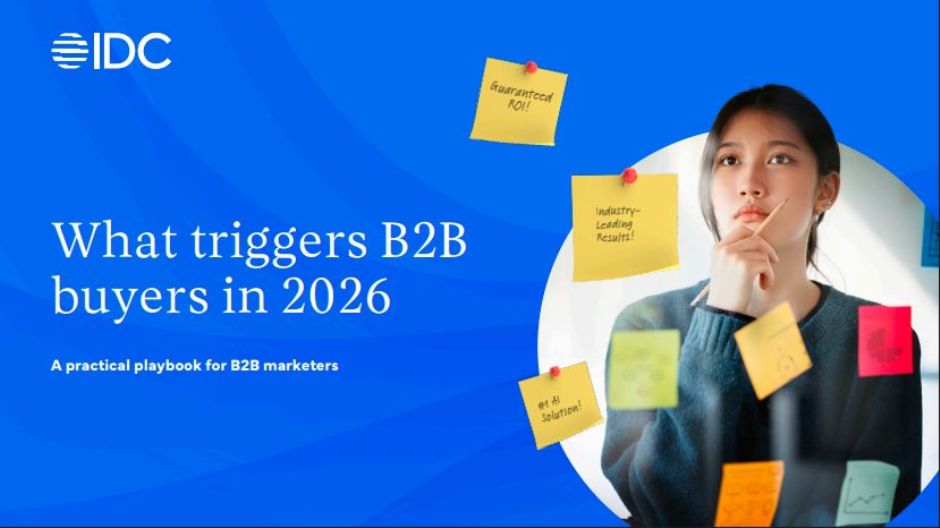
What moves a technology evaluation from curiosity to commitment? This InfotechLead article covers IDC research showing 43% of B2B buyers enter active evaluation to improve operational efficiency and reduce complexity, with 40% citing legacy infrastructure or security risk. It also outlines the five tests IDC says technology messaging should pass. Read the article to see what buyers expect at each stage, then talk with us about applying it to your evaluations.
What is driving B2B tech buying decisions heading into 2026?
IDC’s latest research shows that B2B tech buying is being reshaped by very specific operational pressures rather than broad transformation stories.
Key triggers that push buyers into active evaluation include:
- Operational efficiency and complexity reduction – 43% of B2B tech buyers say improving efficiency and reducing complexity is the main reason they start looking at new technology.
- Adoption of new or emerging technologies – 42% are motivated by the need to adopt new or emerging tech to stay competitive.
- Legacy and security concerns – 40% cite eliminating legacy infrastructure or mitigating security risks as a primary trigger.
For vendors, this means that AI, cloud, cybersecurity, SaaS, and data center solutions need to be framed around immediate operational problems they solve—such as automating manual work, reducing IT complexity, or cutting risk—rather than only promising a long-term digital reinvention.
How important are ROI and proof points in the 2026 tech buying journey?
IDC’s data indicates that measurable business value is now central to enterprise tech decisions, not a nice-to-have later in the sales cycle.
During evaluation, buyers are looking for:
- Financial justification / ROI – 44% say ROI is essential at the evaluation stage.
- Real-world examples – 38% want concrete customer examples that show outcomes, not just features.
- ROI and business-value tools – another 44% specifically want ROI or business-value calculators.
- Peer and analyst validation – 38% look for peer references or analyst reviews.
This creates what IDC calls a “proof gap”: many suppliers still lead with big transformation narratives, while buyers are asking much more practical questions such as:
- What problem does this fix first?
- How quickly will we see results?
- Where does it reduce cost, complexity, or risk today?
To keep deals moving, vendors need to bring evidence forward in the journey—quantified outcomes, benchmarks, case studies, and interactive ROI tools—rather than promising to prove value only after a sales engagement has started.
How are digital self-service and content expectations changing for tech buyers?
IDC’s findings show that tech buying is increasingly self-directed, with buyers expecting to do serious homework before they ever speak to sales.
Key expectations include:
- Digital self-service and contextualized content – 69% of buyers expect to access digital self-service and content tailored to their context during evaluation.
- Fit-to-needs information – 41% say “fit to my needs” and technical product information are among the most useful resources.
- Interactive tools before sales calls – 35% of high-intent buyers prefer interactive content or ROI calculators as their first engagement instead of a sales call.
Practically, this means your website and digital assets are now part of the core sales process. Buyers want:
- Clear problem-solution messaging they can recognize in under 10 seconds.
- Immediate proof (ROI tools, case studies, analyst reports) without filling out long forms.
- Low-risk next steps framed as validation or assessment, not a high-commitment sales conversation.
For AI and other advanced technologies, the bar is even higher: buyers want to see exactly what AI will fix first—whether that’s automating manual work, reducing IT complexity, replacing legacy systems, improving security, or cutting operating costs—before they are willing to move toward a larger commitment.
B2B Tech Buying Trends 2026: 43% Prioritize Efficiency as AI, ROI and Security Drive IT Decisions - InfotechLead
published by Swerve Limited
Swerve is a responsive, 100% Kiwi-owned technology business. We are headquartered in Auckland and service clients across New Zealand.
Our customers are diverse, from the engineering firms that build the infrastructure of the nation, to the Hobbiton team in Middle-earth that warm the hearts of countless international (and local) visitors.
No matter their business, each client enjoys big team capability, delivered with small team agility - and the simplicity of one responsive IT partner for everything.
We believe IT matters
Our purpose: To put people at the heart of technology, as we design, deliver, and support exceptional IT experiences that keep business humming.
Swerve was founded in 1999 and for over 25 years we've taken care of technology because we know IT matters.
IT matters because it powers the engine rooms of the Kiwi economy. Businesses like yours, that is.
IT matters because it protects IP, data, and the lifeblood of livelihoods in an age of sophisticated cyber crime. IT matters for productivity, for communication, for healthy communities, and for everything that keeps New Zealand humming in a digital world.




 Sign in with LinkedIn