How to Escape AI Pilot Purgatory
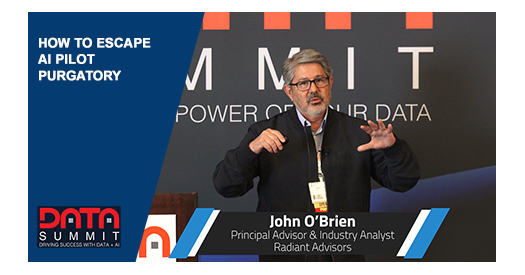
What separates AI projects that reach production from those that stall? In this DBTA article, Radiant Advisors analyst John O'Brien breaks down 2026 AI Market Study findings from Data Summit 2026, pointing to committed AI budgets, traceable model outputs, and automated readiness assessment as markers of production-ready programs. Read the article to see why operational governance is often enough to start moving, and how we can help you apply that thinking.
What separates AI pilots from production-ready AI initiatives?
According to the 2026 AI Market Study presented at Data Summit 2026, organizations that move beyond pilots into production tend to have several concrete elements in place:
- Dedicated AI budget: Production organizations typically commit an AI budget of over $100K, signaling that AI is treated as a strategic capability, not an experiment.
- Traceable model outputs: They ensure AI model outputs are fully traceable—from inputs through to decisions—so teams can verify, audit, and trust the results.
- Automated AI-readiness assessment: They use automated assessments to evaluate whether data, processes, and governance are ready for AI, instead of relying on ad-hoc checks.
John O’Brien’s core message is that AI pilots are not meant to be simply “switched” into production. Instead, organizations need to reimagine how they operationalize AI by investing in budget, traceability, and readiness processes that support long-term, reliable use.
Why is traceability so important for AI success?
Traceability is a recurring theme in the 2026 AI Market Study findings shared at Data Summit 2026. Organizations that are successful with AI in production focus on being able to follow the full path from input to output:
- Verification and trust: Teams need to see which inputs led to which outputs so they can verify that models behave as expected.
- Risk and compliance: Fully traceable outputs make it easier to respond to audits, explain decisions, and manage regulatory or internal compliance requirements.
- Operational reliability: When something goes wrong, traceability helps pinpoint whether the issue is with data, the model, or the surrounding workflow.
As O’Brien puts it, “If you want to do this you have to look at the inputs, you have to look at the outputs.” That level of traceability is what allows organizations to rely on AI in real business contexts, not just in controlled pilot environments.
How much governance do we really need to move AI into production?
The 2026 AI Market Study suggests that organizations do not need to wait for a perfect, enterprise-wide governance framework before moving AI into production.
John O’Brien highlights that “a little governance is better than none.” In practice, this means focusing on operational governance that is specific to how AI is actually used:
- Define which AI agent is doing which workflow in which context.
- Put basic controls around data inputs, model outputs, and how decisions are used.
- Ensure there is accountability for monitoring and improving AI behavior over time.
This kind of targeted, operational governance is often enough to get started and can be expanded over time. It helps organizations reshape their AI efforts from isolated pilots into manageable, production-grade capabilities without waiting for a massive governance overhaul.
How to Escape AI Pilot Purgatory
published by Swerve Limited
Swerve is a responsive, 100% Kiwi-owned technology business. We are headquartered in Auckland and service clients across New Zealand.
Our customers are diverse, from the engineering firms that build the infrastructure of the nation, to the Hobbiton team in Middle-earth that warm the hearts of countless international (and local) visitors.
No matter their business, each client enjoys big team capability, delivered with small team agility - and the simplicity of one responsive IT partner for everything.
We believe IT matters
Our purpose: To put people at the heart of technology, as we design, deliver, and support exceptional IT experiences that keep business humming.
Swerve was founded in 1999 and for over 25 years we've taken care of technology because we know IT matters.
IT matters because it powers the engine rooms of the Kiwi economy. Businesses like yours, that is.
IT matters because it protects IP, data, and the lifeblood of livelihoods in an age of sophisticated cyber crime. IT matters for productivity, for communication, for healthy communities, and for everything that keeps New Zealand humming in a digital world.




 Sign in with LinkedIn